Thursday, June 12, 2014

A visit to Egeskov Castle


                             When visiting Egeskov Castle, there is an obvious sense of wealth. Finding out that this historical castle is still in use and is owned by a count really put things into perspective, it was a very interesting and unique experience. It is true that Denmark is an egalitarian society, so why is this castle such an attraction? I feel as though in this case, although it does not fit in with Denmark and the general mentality, as the Dane’s are simple people who do not boast of wealth unlike other countries, it is an accepted case.  It is important to keep Denmark’s castles preserved and being that it is so expensive; it does take someone such as a count to keep them up and running, and according to the estate manager, even the count’s wealth does not do justice. I enjoyed looking at the many collections that the count’s family has on display, however it does so blatantly go again the egalitarian mentality, these collections are asking to be look and gawked at.


                    However, although it may go against the general mentality of the state, Egeskov does serve as an educational opportunity and aesthetic attraction for the public. Yes, they have bulstered the property up with ridiculous attractions such as Segway rides and Dracula’s Crypt in order to make money, however there are also majorly historical aspects, such as the castle itself and even a dress of Marie Atoinette’s which was a nice surprise. As previously mentioned, I think although Egeskov does not fit in with the egalitarian society of Denmark, it is an acceptation to be made. Given that our class visit was on a Wednesday it was quite busy, so one can imagine how busy of an attraction the castle might be for families and groups on a weekend or during a special event.  Additionally, it is in a very obscure area that is out of the way of most of the public, most of Denmark is probably unaware of this attraction, so I feel as though it is okay and it provides a community benefit and adds to the tourism sector of the economy. 

Wednesday, June 11, 2014

Copenhagen's Forested Areas


               After World War II, the world, and our lifestyles changed as we know it. A major trend that happened in the post war era was the idea of suburbs. More couples were having families (the baby boomers), and they did not want to be in the congested city areas, they wanted a yard, a car, and all of the amenities that may come with living in the country, while still being able to commute to the city for work. Rows, upon rows of suburban how’s began to be planned and built, with little concern or thought of greenspaces being integrated into the suburban set up beside a personal lawn. However, planners in Copenhagen were more innovative, and thus the five finger plan was born in 1947. Each finger has its own type of suburban development that has evolved over the years, and in between each finger are important forested areas that have been purposefully preserved for recreational usage (as well as providing ecological benefits).


           It is in fact true:  these wedges of land between each finger of Copenhagen’s suburban extensions are valuable. With a population of roughly 5.3 million people, and a geographical size of about 43 square kilometers, the country of Denmark has a high level of agricultural output, mostly in the form of pig farming. Nearly 62 percent of Denmark’s land is used for agriculture, which given its size is a very large amount. This means that land is valuable, but also, that it is extremely important to preserve the land, especially the land close to Copenhagen as it serves not only as a retreat for those in the suburban areas, but also for those living in the city center. The five finger plan was designed for this reason and it is integral that it is upheld to its purposes and not turned over for development. When visiting one of the forested wedge areas in class, there were not many people around, given it was a weekday, however it is still an important space where people row crew on the lake, school groups come explore, and people hike. Without these wedges people would have to travel some extra distance, but given Copenhagen’s comprehensive public transportation system, one can easily take the S-train that runs through each finger. 

Friday, June 6, 2014

North Zealand National Park vs. U.S. National Parks


     In visiting Denmark's National Park in North Zealand, it was a very different experience than an American National Park. In the United States, National Parks were created hundreds of years ago and have been rooted in the country and recognized at a worldwide level. Not only does the United States have national parks, but wildlife refuge areas, national monuments, as well as wild and scenic river conservation, among many others. However, Denmark is not nearly as large and diverse of a country in terms of topography and natural wonder as the United States. Yet, it is still important for the country to recognize the significance of conserving an area and turning into a national park where it can remain untouched. In the United States, a National Park is an area in which no automobiles are allowed, no logging, and no hunting is permitted. Albeit, U.S. Parks are huge tourist attractions such as Yosemite and Yellowstone (probably the most well known worldwide). 


    In fact, many complain that national parks have become too touristy and have been made into a commodity with all of the lodging and tours that go on in the park. In Denmark it is very nice that the national parks are much more low key and have not fallen into the tourist trap as in the United States. One big factor that I noticed was very different when visiting the park in North Zealand this week was that the park participates in logging on the land which is something that would never occur in a United Stated National Park. Additionally, the park's management has decided to temper with the ecology of the park, for what seems like good reason, however tempering with the park's ecology in most U.S. National Parks is generally not something that happens (beside reintroduction of species). 

Thursday, June 5, 2014

The Danish Golden Age of Painting


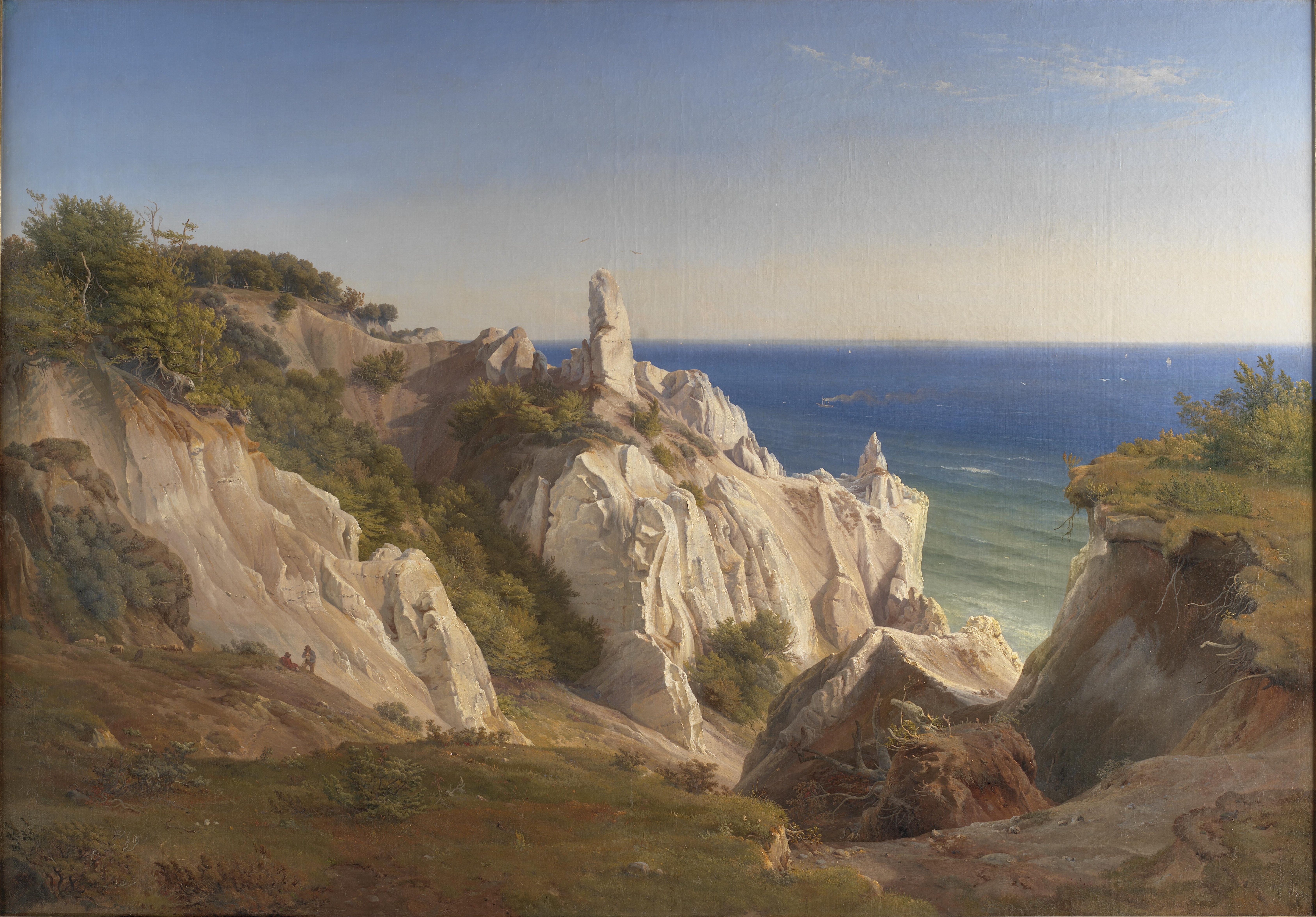
       In the Danish Golden Age, a trend and school or teaching caught on. In this way, it was popular to create landscape art in which people and sometimes animals were featured in the foreground and the landscape was features mostly in the background. A trend was to have the people in the picture there to show the scale of the landscape around them, which was often bolstered up by the artist in an unrealistic way. Danish landscape is not a harsh one, it is vast green lands, with gentle rolling hills and soft coastlines, yet, during the Golden Age the landscape was not depicted that way.  For many years this was the style of painting. Although the paintings were beautiful and are still famous today, they were not realistic.

A golden Age painting by Møns Klint depicting an exaggerated Danish coastline

A move towards larger people pictured in the foreground


 At some point, there was a shift. Artists began to make the landscape look more realistic, and in the museum we saw many paintings of Denmark’s rolling hills, spotted with Viking burials mounds, and a fascination with painting clouds emerged. Also, shifts in techniques used to draw and paint changed throughout this time, and the use of a spatula to create an almost obvious look of the paints presence was used.  Popular, realistic paintings depicting Denmark’s gentle coastline was also created, as well as paintings depicting Denmark’s major way of life, being fishing. These paintings evolved, first they were exaggerated, but towards the end of the Golden Age, a true perception of not only the Danish landscape, but also the Danish culture (often shaped by the land) was depicted in popular paintings. Additionally, towards the end of the Golden Age, a shift towards painting people on a larger scale in the foreground, with a non-exaggerated background also became the trend, which led into artists beginning to paint portraits, as well as the female body. 

A realistic Danish landscape (with Viking burial ground) by Johan Thomas Lundbye 

Wednesday, June 4, 2014

Public and Private Greenspaces: Copenhagen


Copenhagen's public and private greenspaces, offer very different experiences. Those who are interested in having more of an interaction with the land and the soils may opt to want a private garden or greenspace, one they can call their own and have a truly one on one interaction with the natural world. In this way a person can also choose how they want their green space to look and what it will include. Do they want to grow vegetables, flowers, have a big open grass area, a place to sit, beehives, the possibilities are endless with your own private space. In this place you are the creator, a truly great experience. Although these spaces might be smaller than large public greenspaces, they still offer a lot of the same things. These small gardens still serve as a social setting, and allows many to do their favorite hobbies such as gardening, beekeeping, or reading.


    Comparatively, a public greenspace in Copenhagen, will not offer the same type of isolation and private space. These spaces are full of people, young and old, and are part of a lot of recreational activities such as biking, running, and walking. It is a choice people may make, whether to choose a private or public greenspace, however one requires much more maintenance and personal interest than the other. Additionally in Copenhagen it is not an easy task to obtain a private greenspace so many choose public spaces. However, public spaces may be just as visually appealing as a private space. Public greenspaces in Copenhagen are also much more accessible that private spaces as they are located within populated areas of the urban space.

     Yes, these two spaces do vary and their identities are different, however they still offer the public a place to interact with the natural world, or to enjoy recreational activities. While a private setting offers a more secluded greenspace, a public area is more social and interactive. In the end, it is up to Copenhagen's population whether or not they want to spend their downtime in a public space that is readily available, or to possibly have to spend time waiting for the opportunity to host their own private greenspace. It is a personal, compelling decision, but so,etching that is unique to Copenhagen.

Tuesday, June 3, 2014

A tour through tichon


          I was not sure exactly what to expect for our trip to TICKON, but as always I kept an open mind. I enjoy art, but sometimes I don’t necessarily understand the depth of certain pieces, they do not necessarily evoke emotions for me. For Alfio, he is an artist, art is his life, so he feels a very different way towards the art as I might. However, it was still an enjoyable experience, just different than I had expected. I felt very honored to be able to get a tour of TICKON from Alfio, and my experience was very different than if I had gone alone and walked through the premise. I was able to get a feel for the art through the eyes of someone who saw it differently than I did.

         As someone who fully enjoys the natural world and has a deep appreciation for it, I really enjoyed these art instillations. They completely embodied the natural world and looked amazing within the landscape. Sometimes you see modern, colorful sculptures within a landscape and to me that looks unnatural and forced. These works were extremely organic, yet they still evoked emotion and gave the viewer an experience. Alfio described the art as having a life cycle, which was something I really took home and appreciated. These pieces were not like those in a museum; they were not guarded, and kept in pristine condition.  The piece when it was first installed looked one way, but it was not necessarily meant to stay and look a certain way, similar to things within the natural world.  As time goes on, the elements have altered the pieces, but in a beautiful way that makes them evolve further into their life cycle.


 Another point Alfio made that struck a chord with me, was more specific to his piece. Sheep and deer on the premise of Tichon will walk on his piece from time to time, and he enjoys that because it gives the piece a whole new look. Similarly, the sunlight and shadows give a completely different vision of his artwork. These installations were all about incorporation into nature, and their natural deterioration within the landscape, a truly unique place and experience!